
Key Takeaways
- HDPE poly film is essential for efficient vacuolization in automated garment cutting rooms.
- Selecting the right HDPE poly film width prevents air leakage and production interruptions.
- Film thickness impacts its performance during cutting; choose based on ply height and fabric type.
- Synerge Paper Industries specializes in manufacturing HDPE poly film tailored to specific industrial needs.
- Ensure correct dimensions when ordering HDPE poly film to match your cutting machine configuration.
Synerge Paper Industries is a leading manufacturer of HDPE poly film, supplying vacuolization film for CNC auto-cutters used in garment and textile cutting rooms across India and international markets.
In an automated cutting room, small consumable issues can quickly affect the production schedule. When the vacuum film does not seal properly, develops a tear, or does not cover the cutting table correctly, the operator may need to stop the machine and reset the lay.
The result can be unnecessary interruptions during an otherwise streamlined cutting process.
This is why the right poly film should be treated as an important part of the vacuum cutting system rather than simply another consumable. Width, thickness, sealing behaviour, and suitability for the cutting application all matter.
What Does HDPE Poly Film Do on an Auto-Cutter?
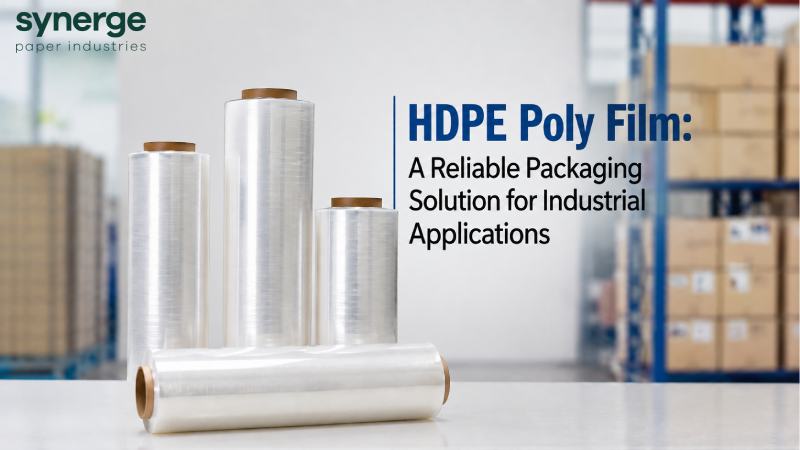
Our HDPE Poly Film, also known in the industry as Morgan Film, HM Poly Film, or Vacuum Poly Film Roll, is used over the fabric layer during automatic cutting.
The film forms a cover over the lay while the vacuum system draws air out from beneath it. This compresses the layers of fabric and helps hold the lay in position while the cutting head moves through the marker.
For the process to work properly, the film needs to maintain a suitable seal and withstand the demands of the cutting operation.
In a production environment, this makes the film an active part of vacuolization rather than just a covering material.
Why Film Width Matters
Film width is one of the first specifications cutting-room managers should review.
When the film is narrower than the cutting table, operators may need to overlap multiple sections and secure the joint. That creates another point where air leakage can occur.
A wider roll can allow the table to be covered with a single continuous sheet, depending on the machine and application.
For example, a cutting room working with a broad table may experience repeated interruptions when two film sections are joined across the lay. Moving to a suitable wider roll can remove the centre seam and simplify the vacuum setup.
The correct width therefore depends on the table dimensions and the way the film is applied.
Choosing the Right Thickness
We supply HDPE poly film in 20-to-30-micron thicknesses to accommodate different cutting-room requirements.
20 Micron
A thinner film can be suitable for lighter applications where the material needs to conform easily around the lay.
25 Micron
A mid-range option can work well for general cutting-room applications where a balance between flexibility and handling strength is required.
30 Micron
Thicker film can be considered for deeper lays and applications where the material needs greater resistance to tearing during cutting.
The appropriate thickness depends on factors such as ply height, fabric type, table setup, and machine operation. Choosing a film based only on thickness without considering the complete application can result in unnecessary material use or avoidable film damage.
A Practical Cutting-Room Example
Consider a garment unit operating a wide automatic cutting table with a relatively deep fabric lay.
If the available film is too narrow, the team may have to overlap two lengths across the table. The overlap can require additional sealing and can become a potential point for vacuum leakage.
Replacing two narrower lengths with a single appropriately sized roll can simplify the setup.
The improvement is not necessarily related to changing the cutter or vacuum pump. In many cases, it begins with selecting film that matches the dimensions of the cutting table.
This is one of the most useful checks when reviewing a cutting-room consumables list.
Our HDPE Poly Film Specifications
Parameter | Value |
Alternate Names | Morgan Film, HM Poly Film, Vacuum Poly Film Roll |
Material Type | HDPE / LDPE Poly Film |
Standard Widths | 40″ to 120″ |
Standard Thickness | 20 to 30 microns |
Application | Auto-cutter vacuolization |
Customisation | Available on request |
The standard width range covers many cutting-table requirements used with automatic cutting systems.
For non-standard tables, custom sizing can also be discussed based on the required application.
As an experienced HDPE Poly Film manufacturer, Synerge Paper Industries can manufacture according to specified dimensions instead of limiting customers to only a fixed stock size.
Where HDPE Poly Film Fits in the Cutting Process
Film is only one part of the complete cutting-room consumables system.
A typical sequence may include:
- Underlay paper is placed on the cutting table.
- Fabric layers are spread according to the marker.
- Poly film is positioned over the fabric lay.
- Vacuum is applied to compress and hold the lay.
- The cutter performs the programmed cutting operation.
The complete setup needs to work together. Incorrect paper, film dimensions, or application methods can affect the overall process.
At Synerge Paper Industries, we also manufacture cutting-room paper products such as perforated underlay, plain underlay, pattern paper, and plotter marker rolls. This gives garment manufacturers the option of sourcing multiple cutting-room consumables from one manufacturing partner.
How to Select the Right Vacuum Poly Film Roll
Before ordering a vacuum poly film roll, cutting-room teams should check a few basic specifications.
Table Width
Measure the actual cutting-table width and determine whether a single sheet can cover the required area.
Ply Height
The typical height of the fabric lay can help determine whether a thinner or thicker film is appropriate.
Fabric Type
Different materials can behave differently during spreading, vacuumisation, and cutting, so testing the film with your regular fabric range can be useful.
Machine Configuration
Confirm the film dimensions and application method against the specific auto-cutter being used.
Order Quantity
For recurring production requirements, businesses should consider their regular consumption and preferred roll format when planning supply.
A sample trial can be especially helpful when changing from one supplier or film specification to another.
Supply for Garment and Textile Cutting Rooms
Synerge Paper Industries supplies HDPE poly film for garment and textile cutting applications in India and overseas markets.
Our Ahmedabad manufacturing location supports supply to customers across Asia, Africa, Europe, and other export destinations.
For international buyers, product specifications should be confirmed before dispatch, so the film width and thickness match the intended cutting-room setup.
We can also discuss samples and custom sizing for businesses operating non-standard cutting tables.
Why Choose Us
Synerge Paper Industries works specifically with garment manufacturers, textile exporters, apparel production units, and cutting-room operations that require dependable consumables for automated cutting. We understand that film requirements can vary according to table width, ply height, fabric type, and machine configuration. Our 40–120 inch width range and 20–30-micron thickness options allow buyers to select a format that matches their production setup, while custom sizing is available for specialised requirements. As an HDPE Poly Film manufacturer, we combine direct manufacturing with application-focused support, making it easier for cutting-room teams to source the film they actually need rather than adapting their process around limited stock sizes.
Conclusion
HDPE poly film is an important consumable in automated garment and textile cutting rooms where vacuolization is used to hold fabric lays during cutting. Selecting the appropriate width and thickness can help simplify film application and reduce issues associated with unsuitable sizing. Synerge Paper Industries supplies vacuolization film in widths from 40 to 120 inches and thicknesses from 20 to 30 microns, with custom sizing available for specific cutting-table requirements. For businesses looking to buy HDPE poly film, the best approach is to match the specification with the machine, table dimensions, fabric type, and typical ply height before placing a larger order.
Looking to buy HDPE poly film for your CNC auto-cutter? Contact Synerge Paper Industries at +91 9727242177 or mohit@synergeindustries.com with your table width, machine model, and typical ply height for the right specification.
Frequently Asked Questions
What is HDPE poly film used for in garment cutting?
It is used as a vacuolization film over the fabric lay during automatic cutting.
What thicknesses are available?
We offer 20-to-30-micron thickness options.
What widths can I order?
Standard widths range from 40 to 120 inches, with custom sizing available on request.
Is the film suitable for Lectra and Gerber cutters?
It is designed for auto-cutter vacuolization applications, including systems commonly used in garment cutting rooms. The final specification should be matched to the machine setup.
Can I buy a sample before a bulk order?
Sample availability can be discussed with our team based on the required specification.